Ahmed Deedat
Ahmed Hussein Deedat (July 1, 1918–August 8, 2005) was a Muslim scholar, writer, charismatic public speaker and Islamic missionary of Indian-South African descent.[1] He was best known for his numerous inter-religious public debates with evangelical Christians, as well as pioneering video lectures most of which centered around Islam, Christianity and the Bible. He also established the IPCI, an internationally renown Islamic missionary organization under whose auspices Deedat wrote and mass produced several booklets on Islam and Christianity. He was awarded the prestigious King Faisal Award in 1986 for his 50 years of missionary work. Deedat aimed at providing Muslims with theological tools for defending themselves against the intense missionary strivings of many Christian denominations. He used English to get his message across to Muslims and the non-Muslims in the western world.Biography
Early Years 1918-1942
| Ahmed Deedat | |
|---|---|
 | |
| Born | Ahmed Hussein Deedat July 1, 1918 Surat, Gujarat, India |
| Died | August 8, 2005 (aged 87) Verulam, KwaZulu-Natal, South Africa |
| Ethnicity | Indian |
| Occupation | Muslim scholar, missionary, orator, public speaker |
| Years active | 1942–1996 |
| Religion | Islam |
| Awards | King Faisal International award (1986) |
| Website ahmed-deedat.net | |
Ahmed Deedat was born in Surat, Gujarat, India in 1918.[3] His father had emigrated to South Africa shortly after the birth of Ahmed Deedat. At the age of 9, Deedat left India to go join his father in what is now known as Kwazulu-Natal. His mother was to pass away only a few months after his departure. Arriving in South Africa Deedat applied himself with diligence to his studies, overcoming the language barrier and excelling in school, even getting promoted until he completed standard 6. However, due to financial circumstances, he had to quit school and start working by the time he was the age of 16.
In 1936, while working as a furniture salesman Deedat came across missionaries at a Christian seminary on the Natal South Coast. The missionaries in their efforts to convert people of Muslim faith, would often accuse the Prophet Mohammad of having "used the sword" to bring people to Islam. Such accusations seemed to offend Deedat and such attacks were to form a major influence on Deedat's subsequent interest in comparative religion. [4]
Deedat got his first break when, while rummaging for reading material in his employer's basement, he came across a book entitled "Izhar ul-Huqq" (Truth Revealed), written by Rahmatullah Kairanhvi. This book which chronicled the efforts of Christian missionaries in India from a century earlier. This book had a profound effect on Deedat and led to the purchase of his first Bible and holding of debates and discussions with trainee missionaries, whose questions he had previously been unable to answer.[4]
His foray into Bible Studies took a more serious turn when he started attending Islamic study classes held by a local Muslim convert named Mr. Fairfax. Seeing the popularity of the classes, Mr. Fairfax offered to teach an extra session on the Bible and how to preach to Christians about Islam.[4] Deedat and a few others were delighted at the opportunity. However, only a few months into the project, Mr. Fairfax had to pull out of his engagement, and Deedat, who was by this point quite knowledgeable about the Bible, took over teaching the class. Which he did for three whole years thereafter and later credited for expanding his horizons significantly towards missionary work.
Early Missionary Work 1942-1956
Deedat's first lecture, entitled "Muhammad: Messenger of Peace", was delivered in 1942 to an audience of fifteen people at a Durban movie theatre named Avalon Cinema.[5]. Over time, Deedat's popularity as a public speaker grew in Durban, to the point that he was invited to speak in other cities in South Africa. A decade later he was filling City halls with audiences numbering in the thousands in cities such as Johannesburg and Cape Town.
A major vehicle of Deedat's early missionary activity was the 'Guided Tours' of the Jumma Mosque in Durban. The vast ornamental Jumma Mosque was a landmark site in the tourist friendly city of Durban. A sophisticated program of luncheons, speeches and free hand-outs was created to give an increasingly large number of international tourists often their first look at Islam. Deedat himself featured as one of the guides, hosting tourists and giving succinct introductions to the Islamic Religion and the relationship between Islam and Christianity.[6]
IPCI and as-Salaam 1956-1986
By 1956, missionary work in the form of frequent public speaking engagements and the popular guided tours of the Jumma Masjid had begun to pay dividends. Enquiries about Islam from the general public in South Africa had started to pour in at an increasing rate. Soon it became apparent that working from the mosque office was not going to be sufficient to handle the demand for literature and to facilitate an increasing number of people showing more than simply tourist level interest in Islam.
Among Deedat's close friends were Goolam Hoosein Vanker and Taahir Rasool, whom many refer to as 'the unsung heroes of Deedat's career'.[7] In 1957, Deedat, together with Vanker and Rasool, founded the Islamic Propagation Centre International (IPCI) with the aim to print a variety of books on Islam and offer classes to new Muslims converts.[8]
In 1958, Deedat also established an Islamic seminary called As-Salaam Educational Institute on a donated 75-acre piece of land located in Braemar in the south of Natal province. [9]
With these newly founded missionary organizations as his backbone, Deedat engaged into a broader range of activities over the next three decades. He conducted classes on Biblical Theology and conducted numerous lectures.[citation needed] Da`wah (inviting people towards Islam) became the dominant factor of his life, with audiences at his lectures often reaching in excess of forty thousand. He also wrote a large number of booklets, distributing millions of copies of these and other free literature across the world.
International Fame 1985-1995
By the early 1980s, Ahmed Deedat's work was beginning to be known outside his native South Africa. In 1985, for instance, he twice rented the prestigious Royal Albert Hall in London to debate Christians contemporaries in front of a packed audience. His international profile was significantly boosted, when in 1986 he was awarded the King Faisal Award for his services to Islam in the field of Dawah (Islamic missionary activity). The award squarely brought Deedat into the international limelight and the attention of the Muslim communities worldwide. As a result, at the ripe old age of 66, Deedat began a new phase in his lifetime mission of empowering Muslims to preach to Christians, a ten-year long period of international speaking tours around the world. He travelled far and wide to Muslim communities from Australia at one end to North America at the other end. Some of his known tours include:
- Saudi Arabia and Egypt (on several occasions)
- United Kingdom (on several occasions between 1985 and 1988, including Switzerland in 1987)
- Pakistan, where Deedat met Zia al-Haq, UAE and Maldives Islands (Nov-Dec 1987), where Deedat was honored by President Gayhoom.[4]
- US Tour Number 1 (late 1986 featuring debates with Swaggart, Robert Douglas and several lectures including two in Arizona)
- Sweden and Denmark (late 1991 featuring three debates)
- US and Canada Tour (1994 tour featuring debate in Canada and lectures in Chicago)
- Australia Tour (his last tour in early 1996 just before his stroke)
Illness and Death 1996-2005
On May 3, 1996, Sheikh Ahmed Deedat suffered a stroke which left him paralyzed from the neck down because of a Cerebral Vascular Accident affecting the Brain Stem, and which also meant that he could no longer speak or swallow.[10] He was flown to King Faisal Specialist Hospital in Riyadh, where he was reported to be fully alert and hence taught to communicate through a series of eye-movements via a chart whereby he would form words by acknowledging individual alphabets read out to him; this way he would form complete sentences.[10]
He spent the last nine years of his life in a bed in his home in Verulam, South Africa, encouraging people to engage in Da'wah (Islam propagation). He was looked after by his wife, Hawa Deedat, and was reported to have no bed-sores at all.[10] He continued to receive hundreds of letters of support from around the world, but was a target to many missionaries who tried to convert him to Christianity, to which he replied -via head and eye movements- with verses from the Bible.[citation needed] In October 2002 Deedat was visited by Reverend Naidoo who requested Deedat to let him read a verse of the Bible in order to inspire him and pray for his healing. Deedat in turn, through his eye-movements—the sole method of communication he had been taught at King Faisal Specialist Hospital after being paralyzed—asked him to read out and explain the moral of the event described in Genesis 19:30.For this the Reverend had no answer and thereafter left the place. A similar later attempt at converting Deedat was made by a young Christian gym owner named Ringo who claimed he could heal Deedat through a miracle by saying "Jesus heal him! Rise up!", however Deedat quoted Matthew 7:21 and then asked him "Why would Jesus tell you this when you came to do such a noble job?"[11][12]
On August 8, 2005, Ahmed Deedat died at his home on Trevennen Road in Verulam in the province of KwaZulu-Natal. He is buried at the Verulam cemetery.[13]
Debates

Deedat's first well-known debate occurred in August 1981 when he debated well-known Christian apologist Josh McDowell in Durban, South Africa.[14] Many of his debates were later broadcast online on Youtube, among other sites.
Debates with Anis Shorrosh
Deedat's memorable tussles with Palestinian-American missionary Dr. Anis Shorrosh first came to public attention when Shorrosh appeared among the audience during the Q&A sessions[15] on two separate occasions during Deedat's summer 1985 tour of the UK (where he debated Dr. Floyd E. Clark in what is now considered another one of his early international works)[4]. Thereon ensued some back and forth between the camps of Deedat and Shorrosh and the result was two highly contentious debates, the first of which, entitled Is Jesus God?[4] took place right away in Dec 1985 at the prestigious Royal Albert Hall in London. The second debate was organized with much fanfare and held in Birmingham, UK on August 7, 1988; entitled The Quran or the Bible: Which is God's Word.[4] This debate spanned a total of 240 minutes including the Q&A session.
Debate with Jimmy Swaggart
Deedat's most famous moment came when he managed to land a debate with televangelist Jimmy Swaggart at a time when Swaggart was one of the leading faces of Evangelical Christianity. The debate entitled Is The Bible the Word of God?,[4] was held in Swaggart's hometown of Baton Rouge, Louisiana in November of 1986 at the University of Louisiana, where it was attended by about 8,000 people.
Henry Hock Guan Teh wrote of the debate,[16]
| “ | The debate is on the reasonableness of their competing faiths which was held at Louisiana State University. Great expectations were generated since both were experienced public speakers. Sadly, Swaggart merely relied on TV showmanship to influence the crowd. When Deedat challenged him to prove the Bible as the Word of God, Swaggart simply quoted John 3:16 and claimed that his life was changed by it. Even such a claim was shattered to pieces when Swaggart’s personal sexual weaknesses were later exposed in the press. | ” |
Deedat never managed to truly capitalize on the international fame of his opponent, however, when over the following six months and subsequent five years, Swaggart was caught twice in damaging sex scandals and lost most of his international following and stature as a tele-evangelist. The debate, however, did capture the imagination of the Muslim world and the Muslims minorities in Europe and North America.
Other Notable Debates
In his US tour of 1986, Deedat also debated Dr. Robert Douglas, PhD (Zwimmer Institute) at the University of Kansas in November 1986 in a debate entitled Crucifixion: Fact or Fiction.[4] Deedat's last major debate entitled Was Jesus Crucified?[4] took place at the Maple Leaf Gardens in Toronto, Canada on July 17, 1994 featuring Wesley H. Wakefield (Bishop General of the Bible Holiness Movement of Vancouver).
In Oct-Nov 1991, Deedat toured Scandinavia where he held three debates and several speeches. Two of these debates where held on successive nights against Pastor Stanley Sjöberg in Stockholm, Sweden. The first of these was entitled Is the Bible the True Word of God? .[4] and the second debate was Is Jesus God?.[4][17]. Deedat then traveled to Denmark where he debated Pastor Eric Bock in Copenhagen in a debate entitled Is Jesus God?[4]
Deedat and the Pope
Needless to say, Deedat had a particular fondness for the Pope. In 1984, he challenged John Paul II to a public dialogue in the Vatican Square, but the Pope responded that he only agreed to a closed conference in his cabin.[4] However, Deedat wrote back that he insisted "that such meeting should be public,". When the Pope stopped answering, Deedat distributed a pamphlet in January 1985 headlined His Holiness Plays Hide and Seek With Muslims.[18]
His Writings and Speeches

Deedat published and mass produced over one dozen palm-sized booklets focusing on the following major themes.[19] Most of Deedat's numerous lectures, as well as most of his debates in fact, focus on and around these same themes. Often the same theme has several video lectures to its credit, having been delivered at different times and different places.
- Is the Bible God's Word?[20]
- What The Bible Says About Muhammad
- Crucifixion or Cruci-Fiction?[21]
- several smaller spin-off titles on specific aspects of Crucifixion
- Muhammad: The Natural Successor to Christ
- Christ in Islam[22]
- Muhammad The Greatest
- Al-Qur'an the Miracle of Miracles[23]
Capitalizing on his popularity in the Middle East following his receipt of the King Faisal Award, Deedat secured a grant to print a collated volume of four of his popular booklets. 10,000 copies of this book titled The Choice: Islam and Christianity were initially printed on April 1993 in a very high quality HB 'silk paper' edition with a striking burgundy cover with gold embossed title.[24] This book was very popular in the 1990s, often available for free at missionary outlets across North America. Subsequently, several printing houses offered to print more and within two years, by June 1995, another 250,000 copies had been printed in several print runs across the Middle East.
Later, a second volume in plain PB entitled The Choice: Volume Two featuring six more of Deedat's booklets collated together was also published. Deedat also widely promoted a South African printing of The Holy Qur'an translation by Abdullah Yusuf Ali with commentary and detailed index. This was widely made available at subsidized costs to the general public and is often mentioned in Deedat's speeches.
Deedat also produced a booklet entitled "Al-Qur'an: the Ultimate Miracle" featuring the theory of 'the Number 19' that was popularized by Arizona-based Egyptian computer analyst Dr. Rashad Khalifa. However, this booklet was later withdrawn from circulation after Dr. Khalifa publicly disclosed some controversial beliefs including his rejection of the entire Hadith literature of Islam.[25]
Criticism
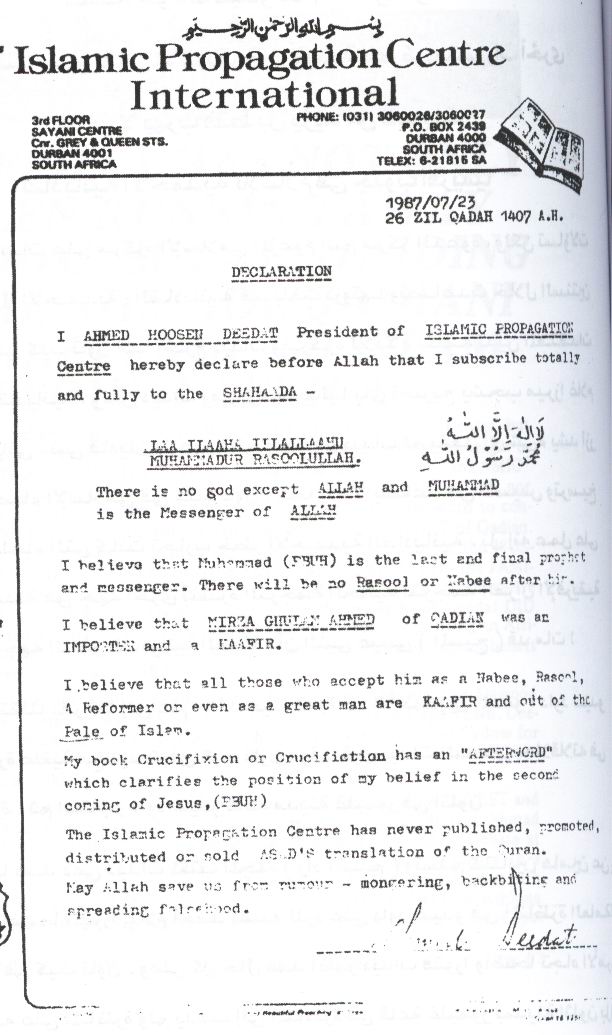
In 1987, Deedat refuted rumors in South Africa that he was a Qadiani and was distributing a Tafseer of the Qur’aan attributed to a well-known Qadian, Muhammad Asad, by issuing a public statement clarifying his stand, re-stating his view that Mirza Ghulam Ahmad al-Qadiani was a 'Kaafir' (i.e. non Muslim), and so were his followers.[26]
Deedat's debates and writings have been labelled a form of apologetics.[2] . Lloyd V. J. Ridgeon, professor of Islamic Studies at the University of Glasgow writes:
Ahmed Deedat's pamphlets are being recycled to a brand new British Muslim constituency. Thus, a new generation is exposed to his malicious new disinformations. The reason for the popularity of such polemicists as Ahmed Deedat is varied: Muslim self-understandings as "the best of all communities" leads them to suppose that Islam prevails over all religions. Combined with the wounded pride of living in a post-colonial world within the continuing hegemony of western culture,some dignity can at least be preserved by claimimg moral and religious superiority.[27]
Still, Deedat's influence was certainly wider than confined to the underground. Muslim scholar Farid Esack has criticized Deedat, comparing him to such fundamentalists as Rabbi Meir Kahane and Jerry Falwell, and writing[28]:
other Deedat's multitude of anti-Christian, anti-Jewish and anti-Hindu videotapes have told us all that there is to be told about the other, and we are comfortable with that. There are times, of course, when questions surface about the importance of correct dogma, about the importance of labels to a God whom we believe sees beyond labels and looks at the hearts of people. Instead of pursuing these questions, we hasten back and seek refuge in "the known." We order anof those Deedat tapes.[28]
The "Stephen Roth institute for the study of contemporary antisemitism and racism" calls Deedat "anti-Jewish" but does not elaborate[29]. In France, his books have been forbidden for sale and distribution since 1994, alleging it to be violently anti-western, antisemitic and inciting to racial hate. [30]
Following his 1981 debate with Deedat, Josh McDowell released a book which included criticism of a number of Deedat's arguments, from a Christian perspective.[31]. Deedat responded to part of McDowell's book in chapters 17 and 19 of "Crucifixion or Cruci-fiction".[32]
In his last tour to Australia, the publicity resulting from the presence of Deedat caused Franca Arena, member of the Legislative Council of the government of New South Wales to comment in her speech concerning racism:
| “ | Of course, other victims of racism are often Australians who are visibly different, especially women who wear Muslim attire. While I condemn such attacks, I also condemn attacks against Christians by Muslims who come to Australia to sow the seed of religious hatred. In this regard I refer to Islamic evangelist Sheik Ahmed Deedat, a South African who, on Good Friday, spoke about Easter, indulged in bible-bashing and incited racial hatred. I am all for freedom of speech, but our leaders should show some understanding and, above all, respect for the views and beliefs of others. Australia can do without people like Sheik Deedat. I do not know why he came to Australia or why he adopted such a confrontationist approach on Good Friday at a big public meeting at Sydney Town Hall when he disparaged the Christian faith. I certainly do not support such an approach.[33]. | ” |
External sources
- Arabs and Israel - Conflict Or Conciliation? by Sheikh Ahmed Deedat
- A List of Deedat's online books
- Islamic Propagation Center International
- High quality video collection of Sheikh Ahmed Deedat's debates and lectures in Windows Media-format
- Video collection of Sheikh Ahmed Deedat's debates and lectures in RealMedia-format
See also
References
- ^ Sheikh Ahmed Deedat - How It All Began, by Fatima Asmal, Islamic Voice, September 2005
- ^ a b David Westerlund, Ahmed Deedat's Theology of Religion: Apologetics through Polemics. Journal of Religion in Africa, 33(3). 2003 "
- ^ Sheikh Ahmed Deedat Islamic Research Foundation. Retrieved on 2009-07-29.
- ^ a b c d e f g h i j k l m n Obituary: Ahmed Hoosen Deedat (1918-2005): by Goolam Vahed, Department of History, University of KwaZulu Natal
- ^ Demystifying Islam and Debating Christianity, Imran Garda, 2006
- ^ Durban See & Do Guide: Jumma Musjid Mosque
- ^ The life of Shaikh Ahmed Deedat By Asim Khan, JANUARY 21, 2006, on Aljazeera.net
- ^ Islamic Propagation Centre International
- ^ Islamic icon leaves behind a legacy, IOL.co.za, August 09, 2005
- ^ a b c Medical Report on Sheikh Ahmed Deedat
- ^ Deedat: The Mission Continues - Fatima Asmal, IslamOnline.net
- ^ A Big Lesson for Us - Soul Talk, Islamic Voice, April 2004
- ^ Muslims Mourn Sheikh Ahmed Deedat
- ^ Was Christ Crucified? - transcript of debate between Ahmed Deedat and Josh McDowell, IsNet.org
- ^ Was Christ Crucified? - video of Deedat's debate with Dr. Floyd E. Clark; Anis Shorrosh seen during Q&A Session.
- ^ Legal Apologetics: Principles Of The Law Of Evidence As Applied In The Quest For The Veracity Of Religious Truth, Henry Hock Guan Teh
- ^ http://web.archive.org/web/20010622110522/home.swipnet.se/~w-20479/extract.htm Extracts from the debate between Deedat & Sjoberg
- ^ His Holiness Plays Hide and Seek With Muslims; Ahmed Deedat
- ^ Islam And Christianity - A Comparative Analysis
- ^ Is the Bible God's Word?, by Ahmed Deedat
- ^ Crucifixion or Cruci-fiction, by Ahmed Deedat
- ^ Christ in Islam, by Ahmed Deedat
- ^ Al-Qur'an the Miracle of Miracles, by Ahmed Deedat
- ^ The Choice: Islam and Christianity, by Ahmed Deedat
- ^ http://islamcalling.com/islam/miracle/miracle1.htm
- ^ Declaration by Ahmed Deedat, Islamic Propagation Center International, 23 July, 1987
- ^ Ridgeon, Lloyd V. J (2001). Islamic Interpretations of Christianity P 214. Palgrave Macmillan. ISBN 0-312-23854-1.
- ^ a b To whom shall we give access to our water holes?, by Farid Esack
- ^ Tel-Aviv University
- ^ Details for individual publications at Légifrance: [1] [2] [3] [4] [5] [6] [7] [8] [9] [10] [11] [12] [13] [14] [15] [16] [17]
- ^ The Islam Debate, Josh McDowell and John Gilchrist, Here's Life Publishers, 1983
- ^ Crucifixion or Cruci-fiction, by Ahmed Deedat
- ^ [18]